Bio-Inspired Functionally Graded Materials in Dental Composites
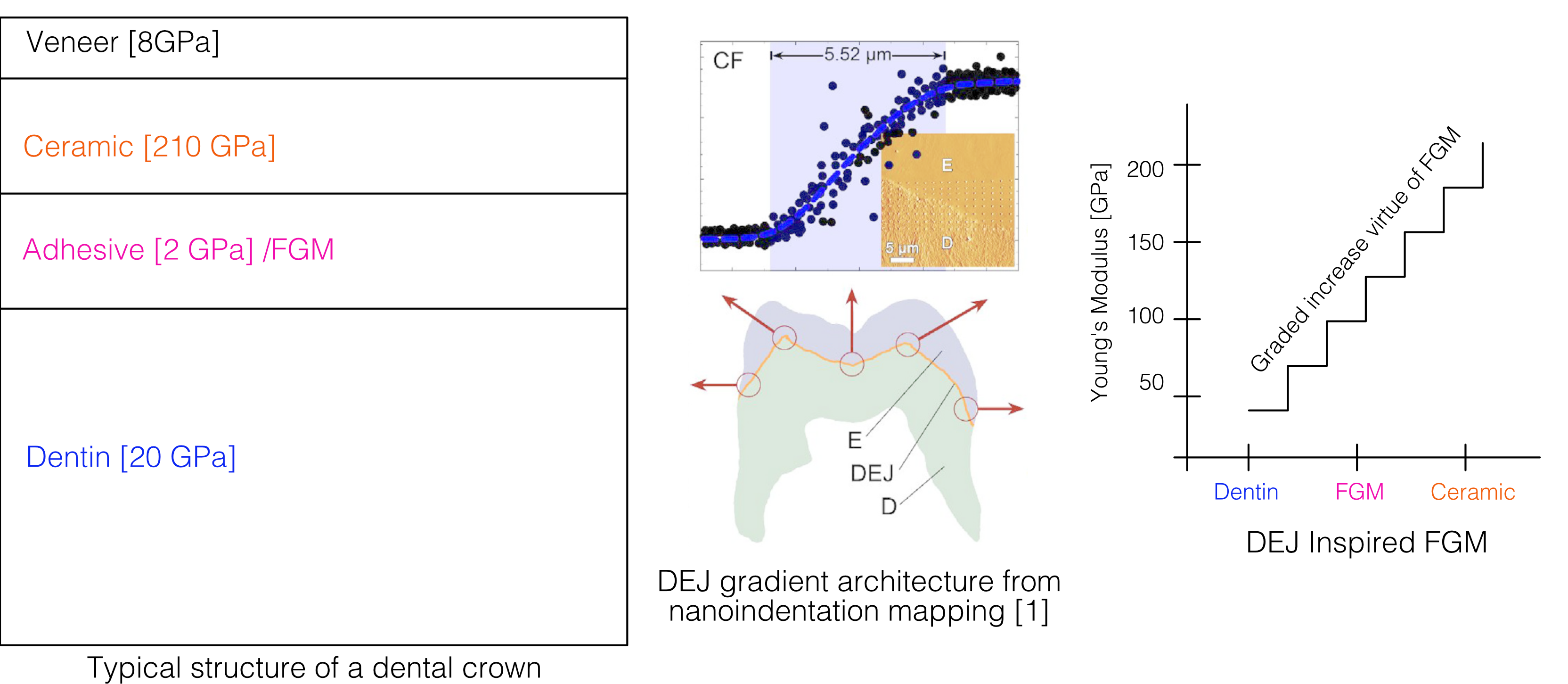
Adults typically develop three to four cavities over a lifetime, although some may experience ten or more [2]. When tooth damage is minor, dentists usually use fillings to restore both function and appearance. However, if the damage is extensive, a dental crown might be needed to offer extra support and protection to the remaining tooth structure [3]. These crowns are custom-made caps that cover the whole tooth, providing strength and lasting quality. They are commonly made from materials like porcelain (veneer) for aesthetics and zirconia (ceramic) for strength [4].
Currently, an all-ceramic dental crown typically lasts 10 to 15 years [5] but can cost between $800 and $2,500 [6]. Consequently, developing more durable and affordable dental materials is crucial. This advancement would improve the lifespan of dental repairs and lessen the financial burden on patients.
The most common site of failure for dental crowns is the interface between the crown and the tooth structure, which can lead to debonding, microleakage, and secondary caries [6]. This is often due to the mismatch in mechanical properties between the crown (ceramic) and the natural tooth structure (dentin), which can lead to stress concentrations and eventual failure at the interface [7]. Therefore, there is increasing scientific interest in creating dental materials that better imitate natural tooth structure while offering improved performance and toughness.
Traditionally, a flat adhesive layer bonds the crown to the tooth. However, using this uniform layer creates a distinct, sharp boundary between the two parts [7]. To overcome the issues caused by this abrupt interface, this research investigates using bio-inspired functionally graded materials (FGMs) in all-ceramic dental restorations.
For comparison, the dentinoenamel junction (DEJ) serves as a natural interface located between the enamel and dentin layers of a tooth; this area naturally shows a gradual change in mechanical properties [1]. Because this property gradient helps distribute stress and prevent failure at the boundary, it represents an ideal model for mimicking natural tooth structure within dental restorations.
Therefore, to replicate the DEJ, this research built a finite element model using Abaqus. The model was used to study how FGMs behave and to examine how different grading patterns affect stress distribution and crown failure. Specifically, the study tested several profiles, such as linear, exponential, sigmoidal, parabolic, and logarithmic. This comparison aims to identify which profile best reduces stress buildup and enhances durability. Ultimately, the findings from this study can guide the design of bio-inspired crowns that more closely resemble natural teeth, thereby improving the longevity of dental restorations.
Furthermore, the importance of this research extends beyond dentistry. The core concepts of bio-inspired design and FGMs are applicable to many other engineering fields, including aerospace, automotive, and biomedical applications. By drawing inspiration from nature's designs, it becomes possible to develop innovative materials and structures that are more efficient, durable, and sustainable.
References
- https://www.sciencedirect.com/science/article/pii/S0109564117305584
- https://www.advanceddentalgermantown.com/how-many-cavities-are-normal-for-every-age-group/
- https://www.druidhillsdental.com/when-to-get-a-dental-crown-key-signs-to-watch/
- https://drdavidbrumbaugh.com/blog/dental-crown-materials/
- https://my.clevelandclinic.org/health/treatments/10923-dental-crowns
- https://www.carecredit.com/well-u/health-wellness/dental-crown-cost-dental-crown-financing/
- https://onlinelibrary.wiley.com/doi/abs/10.1111/j.1460-2695.2011.01581.x